

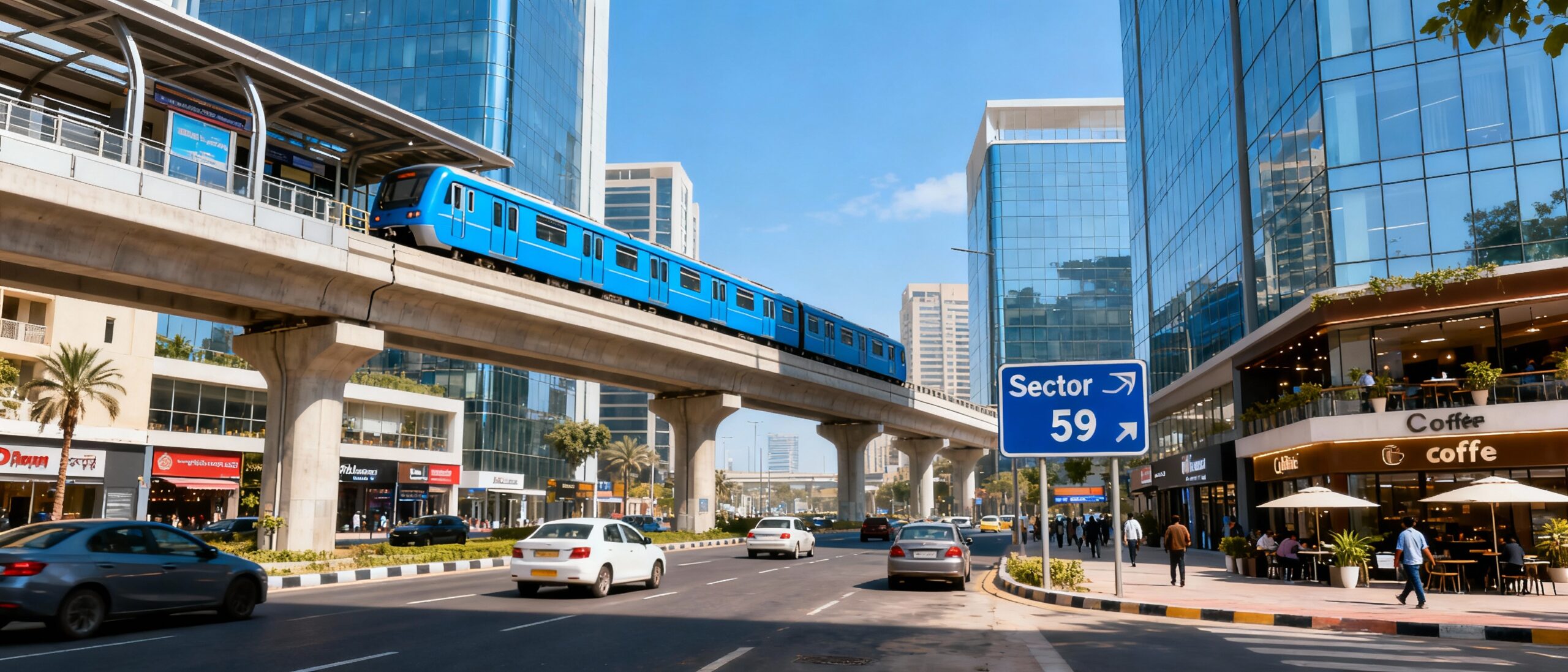
Sector 59 Noida (New Okhla Industrial Development Authority) has transformed over the last three decades from a dusty industrial suburb of Delhi into one of India’s most planned, green, and economically vital cities. Within this sprawling urban landscape, certain pockets stand out as economic engines. Sector 59 is arguably one of the most critical of these engines.
Located strategically in the heart of Noida, Sector 59 is not just a coordinate on a map; it is a bustling hub of commerce, industry, and information technology. While it is primarily known as a workplace rather than a residential retreat, its influence on the real estate, economy, and daily life of the National Capital Region (NCR) is immense.
This article provides an in-depth look at Sector 59, Noida, exploring its connectivity, commercial landscape, real estate potential, and the lifestyle of the thousands who flock there daily.
Introduction: The strategic Location
Sector 59 sits in what can be described as the “Golden Corridor” of Noida. It is flanked by the highly developed Sector 62 (a massive institutional and IT hub) to the east, the residential pockets of Sector 60 and 61 to the west and south, and the industrial belts to the north.
For years, Sector 59 was viewed strictly as an industrial zone, home to garment factories, mid-sized manufacturing units, and printing presses. However, the last decade has seen a metamorphosis. As Noida pivoted towards becoming a software and services hub, Sector 59 evolved. Today, old factory buildings are being retrofitted into modern loft-style offices, and glass-facade IT parks are rising next to traditional industrial plots.
Connectivity: The Lifeline of the Sector
The single biggest catalyst for Sector 59’s recent boom is connectivity. In real estate and business, accessibility is everything, and Sector 59 scores exceptionally high marks here.
The Blue Line Advantage:
The game-changer for this locality was the extension of the Delhi Metro Blue Line. The Sector 59 Metro Station is fully operational and serves as a vital lifeline. This line connects the sector directly to the heart of Delhi (Connaught Place, Karol Bagh) and extends all the way to Dwarka. For the workforce living in West or Central Delhi, the commute is now seamless. Furthermore, the line ends at Noida Electronic City (Sector 62), meaning Sector 59 is part of the final, high-density cluster of the metro network.
Road Networks:
The sector enjoys robust road connectivity. It is situated off the main Udyog Marg, which ensures wide roads capable of handling heavy vehicular traffic. It is in close proximity to the Vishwakarma Road, a major arterial route in Noida.
-
NH-24 (Delhi-Meerut Expressway): The sector is a mere 10-minute drive from NH-24. This makes it easily accessible for people commuting from Indirapuram, Ghaziabad, and East Delhi.
-
Noida-Greater Noida Expressway: While not immediately adjacent, the expressway is easily accessible via internal sector roads, linking the area to Greater Noida and Yamuna Expressway.
The Commercial Landscape: A Hub of Employment
Sector 59 is, first and foremost, a place of work. The demographic here during the day consists of software engineers, factory workers, corporate managers, and support staff.
The IT and BPO Boom:
While Sector 62 grabs the headlines for major MNC campuses, Sector 59 has become the preferred destination for mid-sized IT firms, BPOs (Business Process Outsourcing), and KPOs (Knowledge Process Outsourcing). The rental rates in Sector 59 are generally more competitive than the premium rates of Sector 62 or Sector 16, making it attractive for startups and growing tech companies.
Textile and Manufacturing:
The roots of the sector are industrial. It remains a major hub for garment export houses. Many top-tier fashion export firms have their headquarters or primary manufacturing units here. This creates a unique ecosystem where high-tech software parks exist side-by-side with labor-intensive manufacturing units.
Residential Dynamics: Where do the workers live?
Sector 59 itself is designated primarily for institutional and industrial use. You will not find high-rise luxury condominiums inside the sector boundaries. However, its status as a massive employment hub drives the residential real estate market of its neighbors.
The Rental Economy:
Because thousands of people work in Sector 59, the surrounding areas act as dormitory towns.
-
Sector 60, 61, and 62: These sectors offer organized, middle-to-upper-middle-class housing (mostly RWAs and CGHS societies). Executives working in Sector 59 often rent or buy homes here to minimize commute times.
-
Mamura and nearby villages: For the blue-collar workforce employed in the factories of Sector 59, the adjacent urban villages (like Mamura) provide affordable rental housing. This creates a high demand for budget accommodation in the immediate vicinity.
Social Infrastructure and Amenities
Because it is a working zone, the social infrastructure within Sector 59 is tailored to the needs of employees.
-
Hospitality and Food: The area is dotted with corporate guest houses and budget hotels catering to business travelers. The culinary landscape is dominated by QSRs (Quick Service Restaurants), coffee chains, and a vibrant street food culture that comes alive during lunch hours to feed the massive workforce.
-
Healthcare: While there are small clinics within the sector, world-class healthcare is minutes away. The renowned Fortis Hospital in Sector 62 is less than a 5-10 minute drive, ensuring emergency medical care is accessible.
-
Retail: For shopping, employees and visitors typically head to the nearby Shopprix Mall in Sector 61 or the markets of Sector 62. Sector 59 itself does not have a major mall, but it has plenty of convenience stores and banking facilities.
Investment Potential: The Real Estate Perspective
For investors, Sector 59 offers a specific kind of opportunity: Commercial Real Estate (CRE).
Commercial Leasing:
Buying office space or industrial plots in Sector 59 is considered a sound investment for those looking for rental yield. With the Metro station operational, vacancy rates in office buildings have dropped. Companies are keen to set up offices here because it is easier to attract talent when a workplace is metro-connected.
The “Flip” Opportunity:
Many investors are acquiring older, smaller industrial units and converting them into modern, open-plan office spaces suitable for tech startups. This “retrofitting” trend is generating significant returns on investment.
Residential Impact:
For residential investors, the strategy is to buy in Sector 61 or 66 (near Mamura). As Sector 59 continues to add jobs, rental yields in these neighboring residential sectors will remain robust.
Challenges and Urban Issues
No urban analysis is complete without addressing the pain points. Sector 59, despite its advantages, faces challenges typical of rapid industrialization.
-
Traffic Congestion: During peak hours (9:00 AM and 6:00 PM), the intersections leading into Sector 59, particularly near the Mamura Chowk, can witness heavy gridlock. The mix of heavy industrial trucks, buses, and private cars often overwhelms the infrastructure.
-
Civic Maintenance: As an industrial zone, the aesthetic maintenance of the internal roads sometimes lags behind the polished residential sectors. Waste management from factories is an ongoing challenge that the Noida Authority is working to streamline.
-
Pollution: Being close to manufacturing units and major highways means air quality can be an issue, mirroring the general situation in the NCR.
The Future Outlook
The future of Sector 59 looks decidedly digital. The Noida Authority has been pushing to move polluting industries out of the core city areas, encouraging non-polluting IT and ITES industries to take their place.
We can expect a gradual gentrification of Sector 59. Over the next five to ten years, the remaining heavy industries may move to the outer fringes (like Greater Noida), replaced by data centers, coworking spaces, and corporate towers. The connectivity provided by the Blue Line ensures that Sector 59 will remain relevant. Furthermore, the upcoming Jewar Airport (Noida International Airport) will eventually boost the logistics and export businesses headquartered here, providing them faster access to global markets.
Conclusion
Sector 59, Noida, is a microcosm of India’s economic narrative. It represents the shift from a manufacturing-heavy economy to a service-oriented one. For the job seeker, it is a land of opportunity; for the business owner, it is a location of strategic convenience; and for the investor, it is a steady market with high occupancy potential.
While it may not be the scenic, green-belt-laden face of residential Noida, Sector 59 is its working heart—a place that wakes up early, works hard, and drives the economic engine of Uttar Pradesh. Whether you are looking to set up an office or analyzing the NCR market, Sector 59 is a coordinate that demands attention.